This program was created with the support of the AHOS – All Hands On Stage.
Duration:
The program consists of 3 cycles and is offered free of charge.
It is conducted as a 3-hour class, once a week, during the time period of each respective cycle.
- Cycle A: 03/2023 – 07/2023 COMPLETED
- Cycle B: 09/2023 – 07/2024 COMPLETED
- Cycle C: 09/2024 – 06/2025 ONGOING
Purpose of the Program:
The aim of the program is to train individuals who are interested in becoming theatre educators or who are already theatre educators working in social structures such as prisons. From our team’s experience in similar environments, we identified a strong need for more educators, as well as the development of existing ones. Through this program, we aim to provide the necessary tools to help participants approach educational processes within these social structures—correctional facilities—with empathy, responsibility, and creativity.
A significant aspect of this program is the hands-on practice that participants can engage in from the very beginning of the course to the present, by working alongside our team in correctional facilities under real-life conditions, applying everything they learn during the course.
Content:
- Learning theatrical techniques and practices (techniques by Jerzy Grotowski, Odin Teatret, Tadashi Suzuki, Susan Batson, as well as mime, theatrical clowning, and Noh theatre), and additional practical skills often used in theatre (floor acrobatics, yoga, qigong, juggling – object manipulation), along with techniques from Research Theatre. These serve as essential tools for effectively conducting theatre-based educational processes in correctional facilities.
- Instruction on behavioral codes that educators should apply within a correctional facility—whether interacting with inmates or staff members.
- Through a combination of practical and theoretical stimuli and guidance, participants learn how to organize and apply the knowledge they acquire during their training. This is further reinforced through real teaching experiences alongside our team in correctional institutions.
- Training in understanding and managing the variables that define their system (time, space, number of participants, multiculturalism, gender, physical, emotional, and mental state, etc.), and how to remain flexible and adaptable to different conditions across various facilities.
- Training in supportive techniques for staging a theatrical performance, including theatrical costume design, makeup, hairstyling, and lighting according to the needs of each production.
Location:
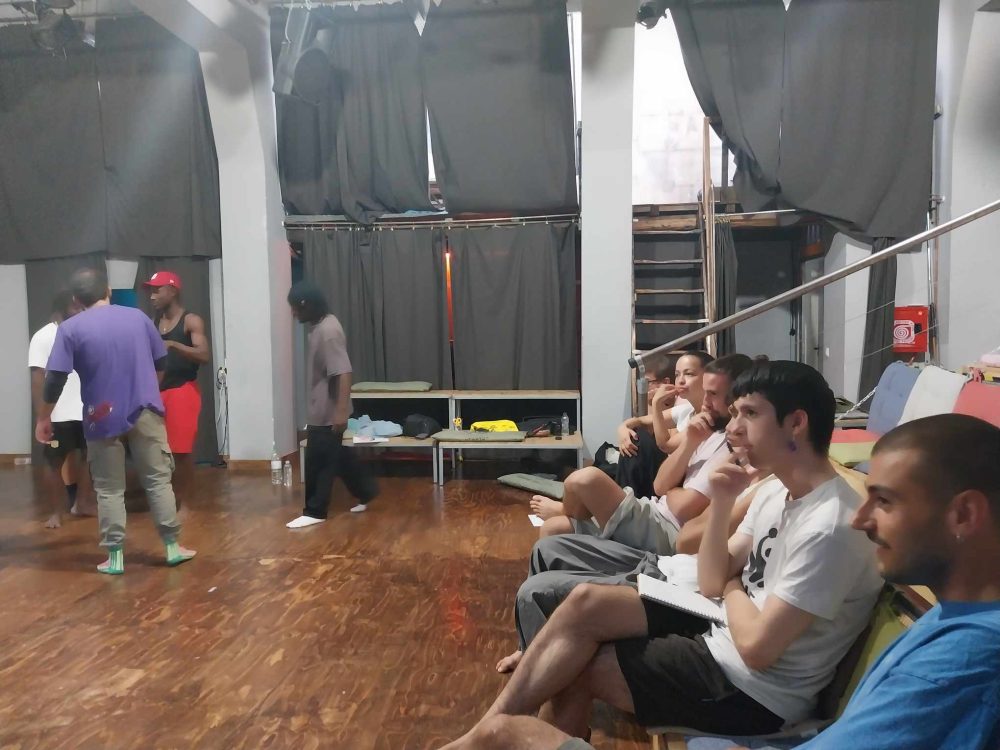
These seminars are conducted in the theatrical spaces of the multifunctional group Fabrica Athens (Fabrica Stage and Rektifie).
Participants:
- Cycle A: 14 participants – 9 women, 5 men
- Cycle B: 18 participants – 13 women, 5 men
- Cycle C: 21 participants – 15 women, 6 men